
Check the (Red) Box
Smoke Signals

Last Friday, the Los Angeles Times ran an interesting story by Seema Mehta with the headline: CODED MESSAGES, ‘RED BOXING’ AND OTHER ALLEGATIONS IN CALIFORNIA’S TESTY RACE FOR GOVERNOR. “Intriguing updates emerged on Democratic gubernatorial candidate Xavier Becerra’s campaign website this week,” she wrote.
Highlighted in bright red text, and boxed by a red outline, was a game plan for attacking one of Becerra’s top rivals in the California governor’s race, billionaire hedge fund founder turned environmental activist Tom Steyer.
Here’s a link to the Becerra’s red box, titled “Big Picture.” It compares the life stories of Becerra and Steyer, with links to articles casting the latter in a less-than-flattering light. The topics are familiar to anyone who’s been following the strange race to succeed Gavin Newsom, including Steyer’s tax shelters in the Cayman Islands, his investments in private prisons, and his experience “making money off Donald Trump’s casinos.”
Was the information in that red box meant for California voters? Mehta asked, or was its intended audience “the operatives running the newly formed big-money independent committees that are backing [Becerra’s] campaign?”
This brings us to “red-boxing,” which Aaron McKean, a lawyer at the Campaign Legal Center defines as follows:
“It’s specifically calling out particular messaging and particular ways of communicating with voters… as a way to get super PACs, nominally independent spenders, to do the bidding of campaigns.”
According to Gabriel Foy-Sutherland, who recently completed his Ph.D. in political science at the University of Chicago, and his co-author Saurav Ghosh, who heads up the Campaign Legal Center’s federal campaign finance reform initiatives, more than 200 candidates for federal office employed redboxing during the 2022 electoral cycle. With the help of the Wayback Machine, they identified 429 instances of redboxing from 240 candidates across 130 House and Senate races. The authors conclude “these same candidates frequently benefitted from super PAC spending that was hundreds of times greater than candidates who did not redbox.” You can read an abstract of their article here.
The authors shared a number of case studies. The Democratic Congressional Campaign Committee, for example, on behalf of Emilia Sykes, the former minority leader of the Ohio House of Representatives and the Democratic nominee for Ohio’s 13 District, shared opposition research on her Republican opponent, former “Miss Ohio” Madison Gesiotto Gilbert:
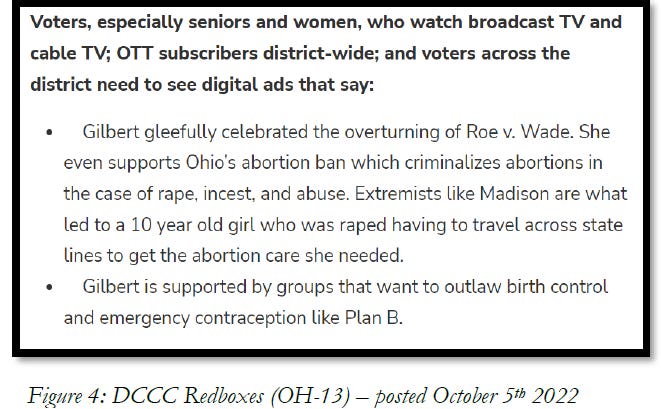
Now check out this ad, from the House Majority PAC, which ran three weeks later:
Sykes defeated Gilbert and won reelection in 2024. In both cycles, outside groups spent heavily on this race. Sykes is running for reelection; five Republicans are seeking the nomination to challenger her. The primary is today, May 5th.
Is Red-Boxing a “Significant Threat”?
Foy-Sutherland and Ghosh conclude “redboxing represents a significant threat to the integrity of American elections,” in part because the practice allows campaigns to “bypass legal prohibitions against coordination with wealthy outside spending groups.” But the authors make an additional point:
We further argue that campaigns employing this strategy may substantially hinder voters from making informed decisions at the ballot box by polluting the informational environment with negative political speech relegated to “independent” outside allies.
This assumes, of course, that the campaigns and affiliated party organizations are doing most of the opposition research, and the outside groups are more or less winging it. That may be true.
It could also be true these independent groups were conducting opposition research and planning to “flood the zone” with negative ads all along, in which case the “red box” merely signals which research topics should be prioritized. In that case, the “red-boxing” would not be responsible for any increase the volume of oppo research-based messaging in a particular race.
For more than a decade, political organizations have been posting their complete opposition research books online, for potential supporters to peruse, a practice which Roll Call named “McConnelling.”
This practice may, like its namesake, be fading.
In 2020, the Democratic Campaign Committee published opposition research books on a section of its main site, titled “Races.” That link no longer works:

The National Republican Congressional Committe at one point posted their oppo research books at www.democratifacts.org. The map is still there; the oppo isn’t.
Before You Go…
Last Friday marked the 25th anniversary of the disappearance of Chandra Levy. She had just finished her internship with the Federal Bureau of Prisons and was packing up to return to California and attend graduation ceremonies at the University of Southern California to collect her master’s degree in public administration. Her body was discovered in Rock Creek Park nearly a year later. Incredibly, her case remains unsolved.
I wrote about the Levy case and the questions surrounding former U.S. Attorney Channing Phillips’ decision to drop all charges against a man named Ingmar Guandique, in Air Mail magazine. If you can’t open the link (there are no gift links) shoot me an email and I’ll send you the PDF.