
The Bulldog
Terry Lenzner, 1939-2020

For three decades, Terry Lenzner ran Investigations Group International (IGI), the firm he co-founded in 1984. His clients included corporations, business leaders, unions, universities, celebrities (Ivana Trump!) and politicians.
Lenzner published a memoir, The Investigator: Fifty Years of Uncovering the Truth, in 2013. He wrote about growing up in Manhattan; earning degrees from Harvard College and Harvard Law School; investigating, as a Justice Department lawyer, the murders of civil rights workers Michael Schwerner, James Chaney and Andrew Goodman; serving in the Nixon Administration (until Donald Rumsfeld fired him); and joining the Senate Watergate Committee staff.
He also wrote about his work as an oppo researcher, starting with Ted Kennedy’s 1994 reelection campaign.
The “Lion of the Senate” was seeking a seventh term. His opponent was Republican Mitt Romney, “the son of a former Michigan governor and a successful Boston businessman with a family as clean-cut and photogenic as he was.”
“A number of embarrassing incidents and scandals were finally catching up with the legendary senator,” Lenzner recalled.
Bob Shrum, Kennedy’s longtime political consultant, was “very worried.”
“A lot of oppo research is, ‘How did the guy vote on this issue or that issue,’” Shrum told me in a recent interview. “All the conventional stuff.” Lenzner, with deep experience working as an investigator for corporate clients, was cut from a different cloth. “Terry was good at delving into things that were not political, which is ideal when you are running against a businessman,” Shrum recalled. “It was clear to me — and nobody disagreed — we needed someone who could go in a different direction.”
Boston lawyer Jim Flug, who was helping the Kennedy campaign, reached out to Lenzner. There was a hurdle to be overcome, something many oppo researchers regularly encounter: money. According to Lenzner: “I sensed that some on the Kennedy team were unhappy that IGI expected to be paid for my services and wasn’t offering them gratis for ‘the cause.’”
Lenzner prevailed. Once under contract, he got to work.
Since Romney was campaigning on his record as a successful businessman and job creator, I told Shrum we ought to fully examine Romney’s company, Bain Capital, and its relationships….
“The question you ought to ask,” I suggested, “is how did Romney become a successful businessman in the first place?” I knew from past experience that there might be skeletons in his closet. In some instances, some of the most prominent businessmen in America—including household names in the country today—have started their careers with a little help from organized crime. I had no reason to expect to find that with Mitt Romney, but I was curious about what we would find.
“If this guy’s a venture capitalist, I want to know what he did,” Shrum recalled. “Because not all venture capitalists behave in ways that will play very well in a political campaign.”
Romney’s firm, Bain Capital, had a “reputation for extreme secrecy.” For its first seven years, it didn’t issue business cards. Employers signed “elaborate confidentiality agreements” and referred to clients by code names. Lenzner and his team put together a roadmap to Bain’s corporate structure. They examined hundreds of pages of documents, articles and SEC filings. They tapped “confidential sources” from Panama to Switzerland.
…[W]e identified six Bain Capital investors who were tied to the powerful oligarchies in El Salvador and Panama. Some of them were accused of funding Panamanian dictator Manuel Noriega. The Salvadoran millionaires were said to have directed and finances right-wing death squads that were trying to destabilize El Salvador’s moderate government and terrorize its supporters with kidnappings, violence, and even murder.
Something intrigued Lenzner:
In many instances Bain would take over a company, invest in it, cut back on employee healthcare and pension benefits, lay off workers, and sell off the less profitable assets. This happened with a company called SCM, in Marion, Indiana. Bain Capital borrowed money to buy the company, loaded it with debt, slashed wages and benefits, and ultimately closed the plant.
This “ruthless practice” struck him as “an issue worth highlighting.”
Lenzner shared his findings with Bob Shrum. When the Kennedy campaign gathered in the Senator’s Boston apartment, Shrum assessed the situation: “I think we have a killer argument,” he said, “but we shouldn’t start with it.”
The Kennedy campaign went live with an ad attacking Romney for opposing a hike in the minimum wage, Meanwhile, Tad Devine flew to Indiana and filmed workers who lost their jobs when Bain Capital closed SCM. I couldn’t locate videos of these ads (there were several versions), but I did find some of the quotes these laid-off workers provided on camera:
“If he created jobs, I wish he could create some here instead of, you know, taking them away.”
“I don’t think Romney is creating jobs because he took every one of them away.”
“They cut the wages…we no longer had insurance…we had no rights anymore.”
“He cut our wages to put money back in his pocket.”
“Romney totally mishandled it,” Shrum told me. “He didn’t really respond.” When workers came to Boston, Romney initially refused to meet with them. According to an NPR report about that campaign, Romney said he had nothing to do with the job cuts. He'd taken a leave of absence from his investment firm before the decisions were made. “But fair or not, the attack stung.”
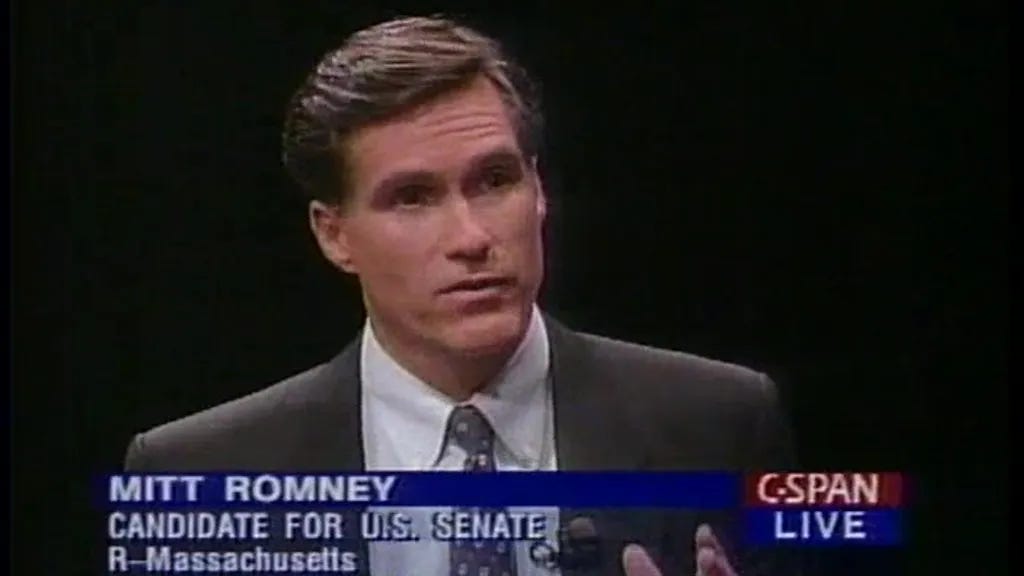
After the ads went on the air, Romney’s team punched back — at Terry Lenzner. From his memoir:
I was one of the first outside investigators hired by a major political campaign to conduct opposition research. I know this is because my hiring became a news story in itself. Payments to my firm were disclosed on the campaign’s financial reports. In order to keep my involvement below the radar, those payments were supposed to go through a law firm. But the filing became public and the press picked it up. So did the Romney campaign. One of Romney’s top guys, Charles Manning, called a press conference to respond to the “revelation” that Senator Kennedy had stooped to hiring a “sleazy” “international spy firm.”
“I thought it was silly,” Shrum chuckled when I asked him about this. “Maybe the Boston Globe was going to write a story about it, but what voters were going to care about was the substance of what we were saying.”
Shrum told me those ads not only drove up Romney’s negatives, they had a positive impact on voter perceptions of Kennedy. “People suddenly remembered again that Kennedy was a guy who fought for ordinary people,” Shrum told me. “He was not attacking Romney; he was standing with those workers.”
“Suddenly we were 15 points ahead,” Shrum recalled.
You can read more about the 1994 Kennedy campaign in Shrum’s memoir.
Once Bitten
Lou DiNatale, director of the Center for Civic and Economic Opinion at the University of Massachusetts, Lowell, looked back on the 1994 campaign in this NPR report:
"The surprise was not that Ted Kennedy came at him this way. The surprise was that Romney didn't seem prepared for it. And even though he had a few bullets in the gun, he never got a shot off."
Romney adviser Manning agreed:
"One of the lessons I think Mitt really learned was, you can't leave it up to the media to tell your side of the story. You've got to go out and set the story right.”
When Romney ran for governor of Massachusetts in 2002, he hired Lenzner’s firm to research his opponent, Democrat Shannon O’Brien, the state treasurer. Romney won that race, 49% to 44%.
In 2006, Lenzner got another call from Romney. “He wanted IGI to find out everything it could in his background so he could be prepared for the attacks.”
One of the attacks John McCain used against Romney in the 2008 Republican primary was the issue Lenzner and his team identified in 1994: Bain Capital and layoffs. "As head of his investment company,” McCain said the day before Florida’s primary election, “[Romney] presided over the acquisition of companies that laid off thousands of workers.”
McCain won the Florida GOP primary. After a disappointing Super Tuesday, Romney suspended his campaign. And in 2012, the Obama team picked up where McCain left off.
When Terry Lenzner died in 2020, his obituary in the Washington Post included this observation:
Admirers said he helped bring “opposition research” into the mudslinging modern era, probing deeper into the lives of clients’ enemies and antagonists, for better or worse, than some of his predecessors had ever believed possible.
The New York Times described him as “a bulldog investigator with a Harvard pedigree.”
Opposition Research in the News…
The House-passed version of new FISA legislation “includes criminal and civil penalties for using opposition research to leak FISA applications or illegal spying."
Famed Democratic campaign consultant James Carville is looking for dirt on Robert F. Kennedy Jr’s running mate, Semafor reports.
American Bridge 21st Century honcho Pat Dennis tells NBC news the best Trump video is raw and unfiltered.
MAGA-aligned group calls its oppo dump Radical Fucking Kennedy, Marc Caputo writes in The Bulwark.