
The $6,250 Question
A Maine Democrat is Vetted - Sorta

Wall Street Journal reporters Tarini Parti and Aaron Zitner have done opposition researchers of both parties a great service, in their June 21 story about the vetting of oyster farmer Graham Platner, the Maine Democratic running for U.S. Senate this year.
“Rushing to launch Graham Platner’s Senate bid,” they write, “Dan Moraff, a progressive up-and-comer and Platner’s top strategist, asked a Democratic research firm to vet the political novice.”
A thorough background check of a Senate candidate, which has become standard practice in key races, can take several weeks and cost roughly $20,000 or a monthly retainer. Moraff asked for an expedited, cheaper review to be done within days, according to people familiar with the matter.
According to Tarini and Zitner, the Platner campaign opted for a “brief, risk assessment memo in lieu of a detailed research book.” The campaign hired Northside Research to do the job, for which it paid a whopping $6,250. Oh, and the deadline for said memo was 72 hours.
At first glance, this seems like a you-get-what-you-pay-for situation.
Northside flagged “some of Platner’s Reddit posts,” but missed “the full trove of Platner’s Reddit posts or sexually explicit texts Platner sent to other women while married.”
That Reddit “trove” was hiding in plain sight. The aforementioned texts, however, were not in the public domain - the candidate’s wife discovered and shared them with the campaign, Parti and Zitner reported in late May - and it seems unfair to blame Northside for the omission.
I will note that neither the candidate nor his chief strategist are pointing fingers. An unnamed campaign aide told the Journal reporters “they didn’t have the resources to do a more extensive vet, which the official said wouldn’t have turned up any more meaningful information.”
"We paid a nice firm a whole chunk of money and got some stuff back," Moraff said in a follow-up interview posted to the Journal’s YouTube channel. "Some of what you've seen on the news we got back, other stuff we didn't." Moraff said Northside did not discover Platner’s tattoo.
(After submitting its “risk assessment memo,” Northside reportedly followed up with “additional limited vetting.”)
Would it have made sense to give Northside more than $6,250 and three days to do its initial work? In hindsight, it couldn’t have hurt.
Lo and Behold
In the 1992 campaign cycle, my firm accepted a similar request to conduct oppo research on the cheap. The fees, I recall, came to something like $2,500 per candidate, about $6,000 today - pretty close to the sum Northside billed the Platner campaign. We found some stuff, missed things that later surfaced elsewhere. Mind you, this was two years before Netscape released its Navigator browser, so the Internet wasn’t available to help oppo researchers do their work.
Today, oppo researchers can provide quite a lot of value for less than $20,000 and month of digging. Just ask Dan Barkhuff, a former Navy Seal and founder of Civly.
While attending Harvard Medical School, Barkhuff started a Facebook group he named Veterans for Responsible Leadership. Following Trump’s election in 2016, the group morphed into a Super PAC. Barkhuff met Sarah Longwell, founder of Republican Voters Against Trump, and befriended fellow Vermont resident Stuart Stevens, who officially joined the Lincoln Project in May 2020. Barkhuff recorded two videos for the group - “Betrayed” and “Conservative” - that racked-up three million views on YouTube alone. (You can read more about Barkhuff’s pre-Civly career in this December 2020 New Yorker profile by Paige Williams.)
After Trump returned to the White House, a frustrated Barkhuff reached out to professors he had met at Harvard. His goal: learn more about Artificial Intelligence, hoping to build a “killer app” that could be of use to like-minded candidates.
“Campaigns spend way too much on legal bills,” Barkhuff told me. His first thought was to use AI to streamline the process of complying with federal and state campaign finance reporting. He came up with a tool that could generate required compliance reports quickly, accurately, and cheaply. But by the time he was ready to pitch the idea, he was too late; most of the campaigns he approached had already selected firms to do that work.
He and his friend Matt Haunauer, a data scientist with a Ph.D. from Indiana University, asked themselves: What if we looked at this from the other direction? What if we could learn more about candidates by mining their campaign finance reports, using AI?
“Lo and behold, we became an opposition research firm,” Barkhuff told me in an interview earlier this year.
The goal of his new firm, Civly, is to “democratize oppo.” Using Claude, the company can make sense of vast fields of data hovering on the Internet, from YouTube videos to the Ashley Madison client database.
The firm generates the first cut of an oppo research report using a proprietary tool trained on actual oppo research books prepared the old-fashioned way. Then an experienced oppo researcher reads through the draft, checking every item manually. In a few days, Civly can deliver a 20-page oppo research book for $7,500.
To build on that and support a campaign through Election Day, Civly offers a subscription-based service it calls the Command Center. Civly can also source and manage an oppo research “concierge” for campaigns that don’t have such capability in-house.
Among veteran oppo researchers, the Platner campaign’s $6,250 investment in a limited vetting of the now-famous oyster farmer prompted eye-rolls and guffaws. But it may point to the new economics of oppo research, for candidates and consultants alike.
Opposition Research in the News…
The office of Pennsylvania State Treasurer Stacy Garrity rejected a request for documents filed under the State’s Right-to-Know Law, asserting the filer - the Pennsylvania Democratic Party - was conducting a “fishing expedition” that was “akin to political opposition research.”
According to Tucker Carlson, President Trump thinks California Governor Gavin Newsom is on track to win the Democratic presidential nomination, forcing his likely opponents to rethink their “candidate positioning and opposition research.”
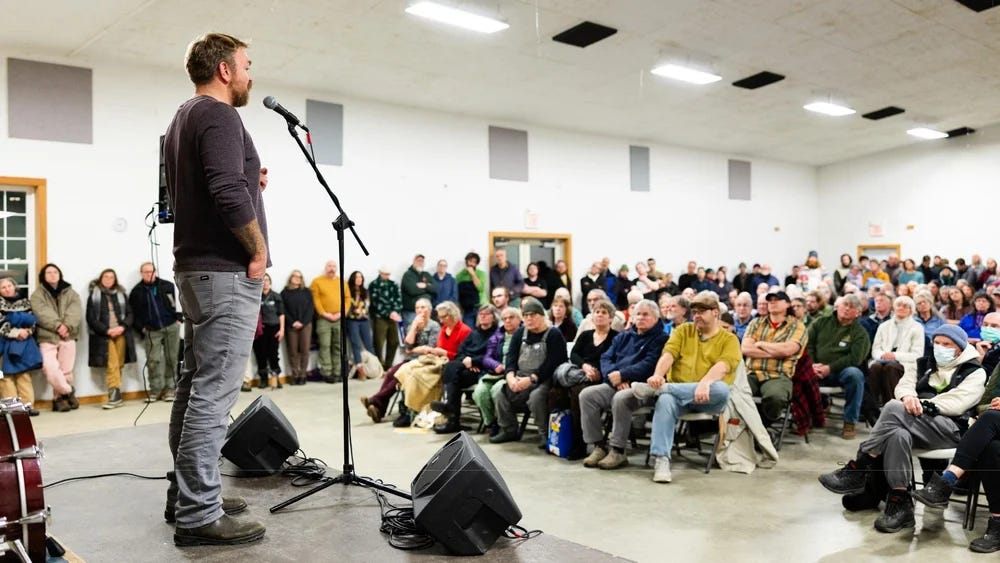
(Photo: Graham Platner for U.S. Senate.)